
LOGIN
Biomass Innovation Design Hub - Hungary
Hub Description
Hungary has a significant potential in the field of agricultural and forest waste and side-streams production. 1-1.2 million m3 forest felling waste and 13.7-18.9 million tonnes of agricultural waste are produced in Hungary annually. Based on these quantities, Hungary can play a major role in valorisation of agro and forest biomass sidestreams for bio-energy production. As the level of bio-energy is still low, additional support including knowledge transfer and innovation support for new sustainable biomass material is needed to achieve 11 % renewable energy production by 2020. In addition to know-how for new biomass, sidestreams for bio industrial usage (chemistry) is needed.
The region originally chosen as focus area of the Agriforvalor project is the South Great Plain of Hungary. This area includes the South-East regions and it is the least forested areas of the country (11.8 %), but it has the highest ratio of tree plantations nationally. Because of unfavourable site conditions the major part of the forest biomass can only be used for production of firewood and pulpwood. In the agricultural sector the grain production and the grazing management are typical. Because of the high ratio of tree plantations and the wide area of agriculture, the region has an abundance of forest and agricultural waste and side-streams that can be used for energy production. Hungary has a well-established Agricultural Knowledge and Information System (AKIS) for the farming and forestry sectors: the National Agricultural and Innovation Centre (NARIC), LAVINA, Pilze-Nagy Ltd. and the Szent István University play a major role in knowledge sharing and innovation. This strong network will converge to establish and implement of the Biomass Innovation Design Hub in Hungary.
The HUB is going to be founded by Bay Zoltán Nonprofit Ltd. and National Agricultural and Innovation Centre; the starting members will be Pilze-Nagy Ltd and Lavina Foundation, all of them are consortium members of the AgriForValor project. Several institutions and companies have already expressed their interest in participating in the HUB which is going to ensure a fair market share of the Hungarian biomass valorisation sector within the Hub. Potential members will be invited directly from among the following types of institutions: practitioners from forest and agriculture, Academia and RTDs specialized on agro and forest based sidestream research and valorisation, Technology Transfer and Innovation support organization clusters and networks, bio-industry, policy, advisory support agencies. The hub is going to be working on the basis of trust and existing cooperation between the Hub members.
The Hub manager will be supported in her role by a Steering Committee that offers virtual and real exploitation and incubation services:
- for exploitation of research results
- for developing new business models for farming and agricultural sector
- liaising with the policy sector in order to ensure that the value of the Hub’s cooperation is visible to policy level and authorities to ensure their support
The Steering Committee will be set up in 2016.
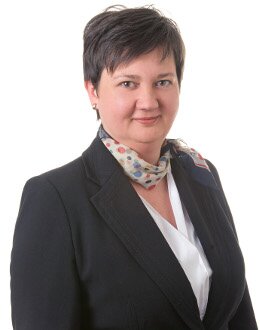
Katalin Kurucz: Hub manager
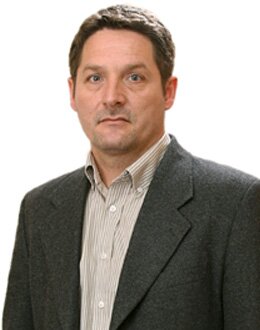
István Kiss: Biotechnology specialist

Akos Koós: Bioenergy specialist

Nora Hatvani: Agriculture and Bioenergy specialist

Attila Benke: Forestry specialist

Adrienn Somosné Nagy: Agricultural enterprise and policy specialist
Organisational chart of the Hungarian Biomass Innovation Design Hub
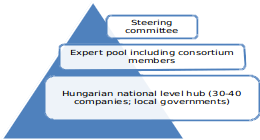
The HUB manager will coordinate regional or national innovation partnership networks (e.g. inter cluster-missions, coordinating input for regional research agenda). The hub manager is Ms Katalin KURUCZ, head of department at Bay Zoltán Nonprofit Ltd. (email: katalin.kurucz at bayzoltan.hu)
The HUB is going to be launched in October 2016 in Hungary at an event where members can meet and discuss personally the cooperation for the AgriForValor project’s objectives.
Agriculture and forestry sector in the Hub
Hungary offers excellent agro-ecological conditions for a competitive production of biomass. Hungarian agriculture is capable of sustainably producing biomass in excess of food and feed demands and at the same time, there is a significant biogas production potential.
The theoretical potential of energy sources of biological origin (bioenergy) could exceed as much as 20% of the energy source demand estimated for 2020, and bioenergy-based electricity production can be planned well in advance, and is also controllable.
The biggest part of the area of Hungary (total of 9.303.000 ha) is a plain, and the climate conditions are suitable for agricultural production. The total agricultural area is 6179300 ha and the different forest area area is 1762900 ha.
Agriculture
“Hungary is a rural country with 66.3% of its area classified as rural, 33.1% as intermediate and only 0.6% is considered urban. 46% of the population lives in rural areas. Compared to the EU average the Hungarian agricultural sector is atypical with very high share of arable farming (81% of agricultural land) and low grassland (14.2%).
Hungary has very favourable agro-ecological conditions for agricultural production, which represent a significant growth potential. (…) Agriculture and food industry are important pillars of the local economy, particularly in rural areas. The average farm size in Hungary is 8.1 ha - much below the EU average; 87% of the farms have less than 5 ha. The average age of farmers in Hungary is 56 years; therefore there is an urgent need for generational renewal. The extent of horizontal and vertical co-operation in the Hungarian agri-food sector is low. The rural employment rate is low, and the unemployment rate for young people and women is especially high compared to the national average.
Concerning climate change, Hungary is frequently hit by important water imbalances between drought and floods and there is a clear need for more efficient water management. Hungary has a limited and outdated irrigation system and only 2.4% of the agricultural area is irrigated. Organic production is among the lowest in EU with 2.7%. Concerning biodiversity 83% of habitats are in poor condition. The main environmental challenges to be tackled concern the protection of biodiversity, the quality of surface and ground water and soil erosion.1
In 2014 2, Hungary produced 2 % of the total agricultural output of the EU. The proportion of agriculture in the production of Hungarian GDP is of 3.7%.
Picture: Number of holdings by main type of farming, Hungary, 2010 (%) Source: Eurostat1 Source: Eurostat 3 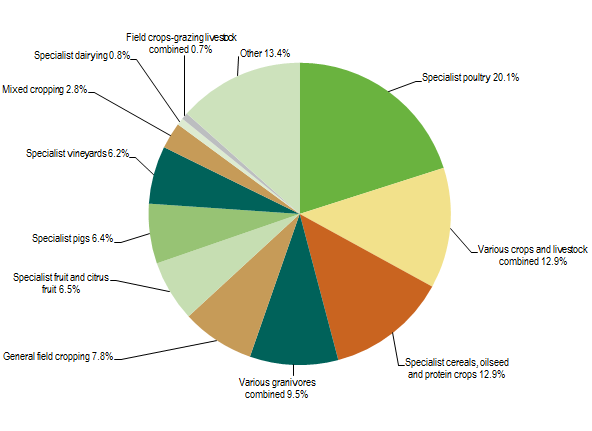
The share of agriculture to GNP is 4,4 %; its share in employment is 4.6% (=445,000 FTE). The gross output of agriculture was of 2410 billion HUF, being 4 % less than in 2013. Out of 7.4 million Ha of farmland, 5.3 million Ha are used for agricultural production, the rest for forestry. Agricultural land covers 57% and forestry 21% of the total territory of the country. The most frequently grown plants in arable farming are cereals (wheat, corn, sunflower, rapeseed).
- Factsheet on 2014-2020 Rural Development Programme for Hungary (downloaded on 13 July 2016) http://ec.europa.eu/agriculture/rural-development-2014-2020/country-files/hu/factsheet-hungary_en.pdf
- A mezőgazdaság szerepe a nemzetgazdaságban, KSH, 2014 (The Role of Agriculture in the National Economy, Central Statistical Office, Hungary, 2014) http://www.ksh.hu/docs/hun/xftp/idoszaki/mezo/mezoszerepe14.pdf
- Source: http://ec.europa.eu/eurostat/statistics-explained/index.php/Agricultural_census_in_Hungary
Biomass situation agro/forest sectors
- 54 million tonnes of dry matter of primary biomass is produced per year (46 million tonnes from agriculture and 8 million tonnes from forestry)
Forest sidestream
- About 13 million m3 of wood is produced every year from the two million hectares of forests in Hungary. Of this, 10.5 million m3 (about 7.5 million tonnes) can be lumbered in a sustainable way.
- Every year about 700,000 m3 (525,000 tonnes) of wood sidestream (waste wood, wood chips) are generated in the wood processing plants. Because these are often contaminated with chemical substances, only about 50 per cent of the resulting quantity, mostly sawdust and bark, can be used for energy production.
Agricultural Sidestream
- Every year 4-4.5 million tonnes of straw originates from the production of grain cereals and of this about 2.4-2.8 million tonnes could be used for energy production in a sustainable way. In addition, 8-10 million tonnes of maize stover is produced annually (more than the weight of the grain). About 2.5-3.0 million tonnes of maize stover could be utilised as biomass for energy production.
- A significant amount of sunflower stems and oilseed rape straw is produced annually, as is about 150-200 thousand tonnes of vineyard biomass and a further 400-500 thousand tonnes of orchard biomass.
85 % of agricultural and food industry waste and biomass comes from plant residues from agricultural plantations and forestry and manure from animal breeding (the latter cannot be considered waste as it is almost 100 % recycled (direct use, drying, etc.). The remaining 15% mostly comes from food industry and is organic waste that needs to be tackled with traditional waste handling methods.
There are about 50 biomass power plants in Hungary.
Hub biomass sidestream usage and potential
The biomass potential of the hub is proportionate to the potential of the general agricultural and forestry sectors in Hungary as the members of the hub cover a fair proportion of the biomass producing sectors.
Sidestream is already used, mainly for energy production. Other uses of sidestreams are also possible and the activities within the Agriforvalor project will contribute to raising this proportion and introducing new technologies in the market.
Hub Contact
Hub manager: Katalin Kurucz
Email:
Phone: 00(36) 1 463 0550